



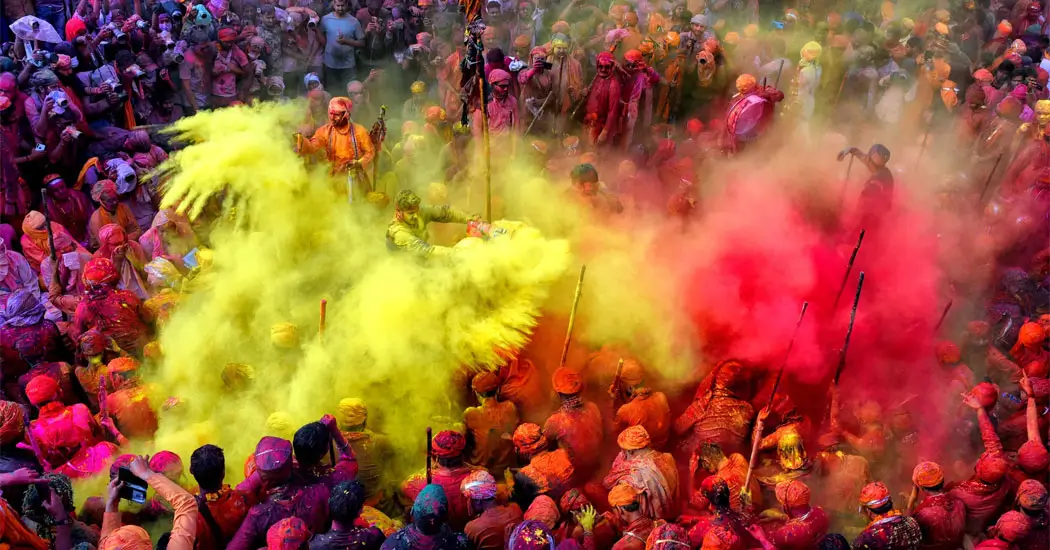
Holi in India is not simply a joyful festival or a visually stunning celebration; it is a cultural manifestation deeply rooted in the country's history, spirituality, and social life. During Holi, hierarchies dissolve, differences are suspended, and human interaction takes on a new dimension. Colors thrown into the air, shared laughter, and traditional music combine to create an experience that unfolds both in the streets and in homes.
For Spanish-speaking travelers, understanding Holi in India means going beyond the iconic images. This festival has religious, social, and emotional significance that explains why it is celebrated with such intensity in different regions of the country. Every gesture, every color, and every ritual has an origin that connects the past with the present.
Holi has roots that go back to ancient texts and legends passed down through generations. The celebration is associated with the victory of good over evil, a recurring theme in Indian tradition. In many regions, Holi symbolizes the end of winter and the arrival of spring, a time of renewal in both nature and human life.
This symbolic nature explains why Holi in India is experienced as a collective rebirth. People leave behind resentment, conflict, and social differences to reunite in joy. It's not just about throwing colors, but about restoring connections and beginning a new cycle with positive energy.
Discover the True Meaning of Holi
Beyond the colors, Holi celebrates the arrival of spring and the victory of good over evil. Immerse yourself in this unique tradition and experience India authentically.
The colors that dominate Holi are not random or merely decorative. Each shade represents emotions, values, and moods. Red is associated with love and fertility, yellow with energy and spirituality, green with new beginnings, and blue with divinity.
During Holi in India , colors cover faces, clothing, and public spaces, temporarily erasing social differences. This symbolic act reinforces the idea of equality, where everyone participates in the same celebration regardless of age, origin, or status.
One of the most fascinating aspects of Holi is its communal nature. Unlike other festivals that take place in private or specific religious spaces, Holi in India unfolds in streets, squares, and entire neighborhoods. The celebration begins early and continues for hours, with music, impromptu dances, and spontaneous encounters.
The communities organize themselves to share traditional sweets, festive drinks, and folk songs. For foreign visitors, this openness is striking, as hospitality is expressed directly and generously.
Holi isn't limited to just one day. Preparations begin days in advance, when markets fill with colored powders, traditional sweets, and utensils. In many regions, pre-holi rituals are performed that symbolize the removal of negative energies.
This preliminary phase helps us understand that Holi in India is a process, not an isolated event. Families clean their homes, prepare special meals, and organize themselves to receive friends and neighbors, strengthening social bonds.
For those visiting India, experiencing Holi can be a transformative experience. However, understanding the cultural context is important to fully enjoy it. Participating in Holi in India requires respect, openness, and a willingness to join in a collective celebration.
Travelers are often surprised by the emotional intensity of the festival. Beyond the colors, Holi generates a sense of belonging that remains in the memory long after the colors fade.
Although Holi is celebrated throughout the country, each region brings its own unique nuances. In the north, the celebration tends to be more intense and prolonged, while in the south it takes on more discreet and ritualized forms. In rural areas, Holi preserves ancestral traditions that contrast sharply with urban celebrations.
This diversity demonstrates that Holi in India is not a uniform experience, but a cultural expression adapted to local contexts.
Music plays a fundamental role in Holi. Traditional songs, drums, and local rhythms accompany the celebration from dawn. The dance arises spontaneously, without formal choreography, reflecting the freedom that characterizes the festival.
For the traveler, this musical dimension offers a direct connection to Indian popular culture, where the body and emotion are expressed without restrictions.
Holi is also celebrated through food. Traditional sweets, festive drinks, and regional dishes are an essential part of the experience. Sharing food during Holi in India strengthens the sense of community and hospitality.
These flavors, specially prepared for the occasion, convey the importance of the festival in everyday life.
Plan Your Holi Experience Today
Don't just read about Holi — experience it. Plan your trip and be part of this unique festival that transforms the streets into a celebration of color and life.
Although Holi is a joyful celebration, its spiritual foundation remains present. Many people visit temples, make offerings, and participate in rituals that connect the celebration to deep religious values.
This balance between spirituality and popular celebration makes Holi in India a unique festival, where the sacred and the festive coexist naturally.
Participating in Holi requires cultural sensitivity. Wearing appropriate clothing, respecting private spaces, and understanding personal boundaries are essential. Although the celebration is open to all, mutual respect ensures a positive experience for everyone.
For travelers, learning about Holi in India beforehand allows for a conscious and enriching integration.
Beyond its aesthetic appeal, Holi leaves a profound emotional mark. Human contact, shared laughter, and the temporary suspension of social norms create a feeling of freedom that is difficult to describe.
Many travelers remember Holi in India as one of the most intense moments of their lives, not because of the colors, but because of the human connection that is created.
Holi encapsulates many aspects of Indian identity: diversity, spirituality, community, and the celebration of life. This festival demonstrates how ancestral traditions remain alive in contemporary society.
Understanding Holi in India helps to understand the country as a whole, beyond monuments and landscapes.
Con 18 años de experiencia y 6 visitas a España, entiendo tu idioma y estilo de viaje. Si nuestros paquetes te interesan, contáctame. Si no, también puedes escribirme — te daré asesoría gratuita y las mejores tarifas para tu viaje a India.
Representa renovación, unión social y celebración de la vida.
Sí, muchas familias participan juntas en la celebración.
No, también se vive en hogares, templos y comunidades privadas.
Ropa cómoda y que no importe manchar, preferiblemente de colores claros.
No, cada región tiene formas propias de celebrar el festival.
Sí, siempre que se respeten las costumbres locales y se actúe con sentido común.
La festividad principal dura un día, aunque las celebraciones pueden extenderse varios días.
Tiene raíces espirituales, pero se vive también como una celebración social y cultural.
Los colores simbolizan emociones, renovación y la igualdad entre las personas.
Es un festival tradicional que celebra la llegada de la primavera y la victoria del bien sobre el mal.